

Blackjack is one of the few casino games where the decisions you make actually change your odds, unlike slots or roulette, where every spin is independent of the last. Blackjack rewards players who understand the rules and play a consistent strategy. This guide walks through everything a beginner needs: how the game works, what the cards are worth, the moves available on every hand, and the basic strategy decisions that keep the house edge as low as possible.
What Is Blackjack?

Blackjack, also called 21, is a card comparison game played between a player and a dealer. The goal isn’t to hit exactly 21 every time — it’s to finish with a hand value higher than the dealer’s without going over 21. You’re not competing against other players at the table; everyone plays against the dealer individually, which is part of why the game feels approachable even for first-timers.
Card Values in Blackjack
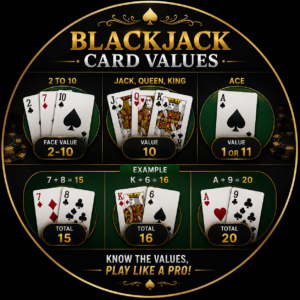
Before you sit down at a table, it helps to know exactly what each card is worth:
- Number cards (2 through 10) are worth their face value.
- Face cards (Jack, Queen, King) are each worth 10.
- An Ace can count as either 1 or 11, whichever helps your hand more.
A hand containing an Ace valued at 11 is called a “soft” hand (for example, Ace-6 is a soft 17), because the Ace can drop to 1 if you draw another card and bust. A hand without that flexibility, or one where the Ace must count as 1, is a “hard” hand. This distinction matters because basic strategy treats soft and hard hands differently.
How a Round of Blackjack Works
- Place your bet before any cards are dealt.
- You and the dealer each receive two cards. Your cards are usually dealt face up; the dealer has one card face up and one face down (the “hole card”).
- If your first two cards total 21 (an Ace plus a 10-value card), that’s a “blackjack” and typically pays out at 3:2 unless the dealer also has one, in which case it’s a push.
- You then decide how to play your hand using the actions below.
- Once every player has finished, the dealer reveals the hole card and plays according to fixed house rules, usually hitting until reaching at least 17.
- Hands are compared: closest to 21 without busting wins.
The Actions You Can Take
Hit
Take another card. You can hit as many times as you like until you either stand or go over 21 (bust).
Stand
Keep your current total and end your turn. Use this when you’re satisfied with your hand or when hitting carries too much risk of busting.
Double Down
Double your original bet in exchange for exactly one more card, then stand automatically. This is typically used when your first two cards put you in a strong position to beat the dealer’s likely total, such as a hard 11.
Split
If your first two cards are a pair, you can split them into two separate hands, each with its own bet equal to your original wager. You then play each hand independently.
Surrender (where offered)
Some tables let you forfeit half your bet and end the hand immediately, before playing it out. This is useful for a small number of genuinely weak starting hands against a strong dealer upcard.
Basic Strategy: The Core Decisions
Basic strategy is a set of mathematically derived decisions for every possible combination of your hand and the dealer’s upcard. It doesn’t guarantee a win on any single hand, but played consistently over time, it brings the house edge down to roughly 0.5% on most standard tables — far lower than nearly any other game on the casino floor. Here are the principles that cover the large majority of situations:
- Hard totals of 17 or higher: always stand.
- Hard totals of 8 or lower: always hit, since there’s no risk of busting.
- Hard 12–16: stand if the dealer shows 2–6 (a “weak” upcard likely to bust); hit if the dealer shows 7 or higher.
- Hard 11: double down unless the dealer shows an Ace.
- Hard 10: double down against any dealer upcard of 9 or lower.
- Soft 18 (Ace-7): stand against a weak dealer upcard (2–8); hit or double against a strong one (9, 10, Ace).
- Pairs of 8s and Aces: always split.
- Pairs of 10s: never split — a hard 20 is already a strong hand.
- Pairs of 5s: never split — treat them as a hard 10 and double down instead.
Most casinos allow you to keep a basic strategy chart at the table, so you don’t need to memorize every rule before you play. The key is consistency: the strategy only works as intended when followed the same way every hand, regardless of how the last few hands went.
Common Beginner Mistakes
- Taking insurance: when the dealer’s upcard is an Ace, you may be offered a side bet that the dealer has blackjack. It’s a tempting safety net, but mathematically a poor bet for most players over time.
- Standing too early on hard 12–16: fear of busting leads many beginners to stand even when the dealer’s upcard makes hitting the statistically correct play.
- Chasing losses by deviating from strategy: changing your decisions based on a losing streak doesn’t change the odds of the next hand.
- Ignoring table rules: the exact house edge shifts depending on rules like how many decks are used and whether the dealer hits or stands on soft 17. Reading the table’s rules before sitting down is worth the extra minute.
Frequently Asked Questions
Is blackjack a game of skill or luck?
Both. The cards you’re dealt are random, but how you play them is entirely within your control. Skilled, strategy-based play significantly lowers the house edge compared to playing on instinct.
What does it mean to “bust”?
Busting means your hand total goes over 21, which results in an automatic loss regardless of what the dealer ends up with.
Do I need to memorize a basic strategy to play well?
Not immediately. Most live and online tables allow you to reference a basic strategy chart while you play, so you can apply correct decisions from your first hand and build familiarity over time.
Fair note: Blackjack should always be played for entertainment, with money you can comfortably afford to lose. If gambling stops feeling fun, it’s a good time to take a break and set firm limits before playing again.